

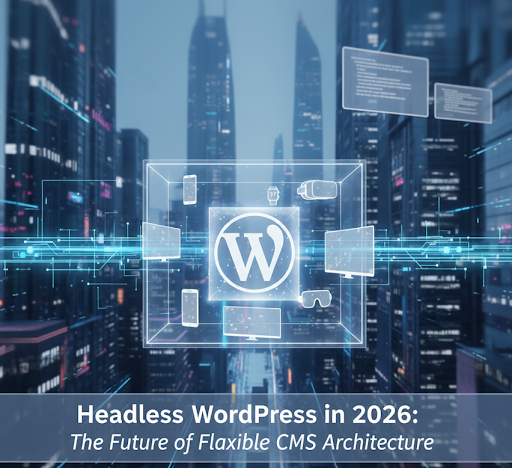
Imagine a body that works without a head! Sounds horrific…Right! Headless WordPress is somewhat similar where WordPress functions purely as a content backend, managing content, while a separate, custom frontend built with modern frameworks like React or Vue displays the content via APIs (REST or GraphQL).
Headless WordPress development introduces greater technical complexity, higher initial development costs, and requires developers with specialized expertise in modern frontend frameworks and APIs.
Are you looking for CMS systems that handles the presentation for every device, with maximizing the quality of the website?Don’t worry! You’ve landed on the right page, here we’ve unlocked detailed information about how headless wordpress benefits your website, with welcoming a huge traffic.
Let’s explore!
Key takeaways:
- A headless WordPress lets you distribute content on various channels. It decouples your website’s content database for more flexibility.
- Complex web applications, e-commerce platforms, or sites needing high performance and unique UIs.
- Headless WordPress development services are more suitable where developers want to use modern JavaScript frameworks.
- WordPress powers about 43.5% of all websites which is still miles ahead of Shopify, Wix, Squarespace.
- Next.Js, Gatsby, Vue.js are some of the top frameworks used in headless websites.
Now, let’s move ahead to know what headless wordpress is, and how it’s beneficial for modern websites.
What Is Headless WordPress?
WordPress becomes the backend “Brain”, and any technology can be the frontend “face”. Still confused?..So basically, headless wordpress is a modern way of using WordPress where it manages content only, while the frontend (what users view) is built separately using modern technologies. Hire WordPress developers who combine creativity with clean, reliable code.
Let’s just simplify this, by how Headless WordPress are different from Traditional WordPress?
| Headless WordPress | Traditional WordPress |
| 1. Headless WordPress handles contents only. | 1. While, traditional wordpress handles content+design. |
| 2. Frontend is built separately (React, Next.js ,Vue, mobile apps etc.) | 2. It allows you to build with themes such as PHP, HTML, CSS. |
| 3. Content is delivered throughout the ecosystems of digital world. | 3. Pages run only on the server side. |
| 4. It is well known for fast, scalable, multi-platform experiences. | 4. Traditional wordpress are best for blogs, and standard websites. |
| 5. Headless wordpress is primarily used for large-scale, high-traffic, and enterprise-level websites. | 5. While, traditional version are only focused on building websites with simplicity. |
Now, let’s just know how headless CMS works!
How Does Headless CMS Work?
The headless CMS architecture follows a simple process:
- Content Creation: Content editors use the WordPress admin dashboard to create and organize content.
- Storage and Management: Content is stored in a database with structured fields, tags and metadata.
- API delivery: Instead of pushing through a theme engine, the CMS exposes content via APIs such as REST or GraphQL.
- Front-end (The Head): Developers use frameworks such as React, Vue.js to fetch content and render it dynamically on the front-end.
- Backend (The Body): The headless CMS manages context (Text, images, data) in a repository, making it available as raw data.
Let’s grab some of the top benefits of headless wordpress!
Key Advantages of Headless WordPress
Headless WordPress offers numerous benefits to the web city such as performance, security, scalability, and flexibility by decoupling the content management (backend) from the presentation layer (frontend).
Performance
Headless WordPress makes websites feel fast and smooth. Pages load almost faster because content is prepared in advance and delivered from nearby servers. Users don’t have to wait, which also keeps them engaged longer. Faster sites also rank better on Google, helping more people find your content easily.
Enhanced Security
With Headless WordPress, the admin dashboard stays hidden from the public. This means hackers have fewer ways to attack your site. Since the frontend and backend are separated, even if something goes wrong on the website, your content and data remain safe behind the scenes.
Improved Scalability
Designers and developers have freedom to create any look or experience they imagine. This allows brands to stand out with unique designs, smooth animations, and modern interfaces that truly match their identity.
Omnichannel Publishing
Headless WordPress lets you manage content in one place and show it everywhere. The same content can appear on websites, mobile apps, smart TVs, or even future devices. You update content once, and it automatically reaches all platforms without any extra coding or efforts which includes lots of time.
Future-Proof
Technology changes fast, but headless wordpress keeps you ready. You can easily redesign your website or switch to new platforms without changing your content system. It also works well with AI tools, personalization, and analytics, helping your digital presence grow with your future needs.
So, there are endless advantages for introducing headless wordpress in building your website, but as we know every cup of tea comes with some spills. Let’s know some of the challenges of Headless WordPress.
Challenges of Headless WordPress
Headless wordpress have to go through facing some challenges before deep diving into exciting opportunities. Let’s witness some of the challenges that bring hurdles in wordpress development.
Higher-Development Cost
More technical expertise requires more initial development cost. It leverages higher cost for building a custom front-end with React or Next.Js requires more technical expertise and time.
Loss-of Plugins for Frontend
It’s true that wordpress includes lots of plugins and themes, but does it actually go perfect for a headless front-end? WordPress plugins designed for themes (for example, sliders, page builders) won’t work directly on a headless front-end.
SEO Complexity
Traditional SEO plugins like Yoast may not integrate smoothly with headless setups. Developers often need to handle metadata and schema manually.
Hosting Requirements
You may need separate hosting environments for wordpress (backend) and your front-end framework.
Learning Curve
Teams familiar with WordPress themes may struggle with API-based development.
Conclusion
In this article, we’ve witnessed how headless wordpress are becoming the global default. As business wants more freedom, developers want flexibility, while users look for speed and personalization. Brands always go with systems that scale effortlessly and integrate with the fast-growing ecosystem of AI, automation and cloud-native technologies. Headless architecture delivers all of these and works more beyond.
Headless WordPress blends the familiarity of a trusted CMS with the freedom of future-ready architecture, making it a smart foundation for websites, apps, and digital experiences yet to come.

