

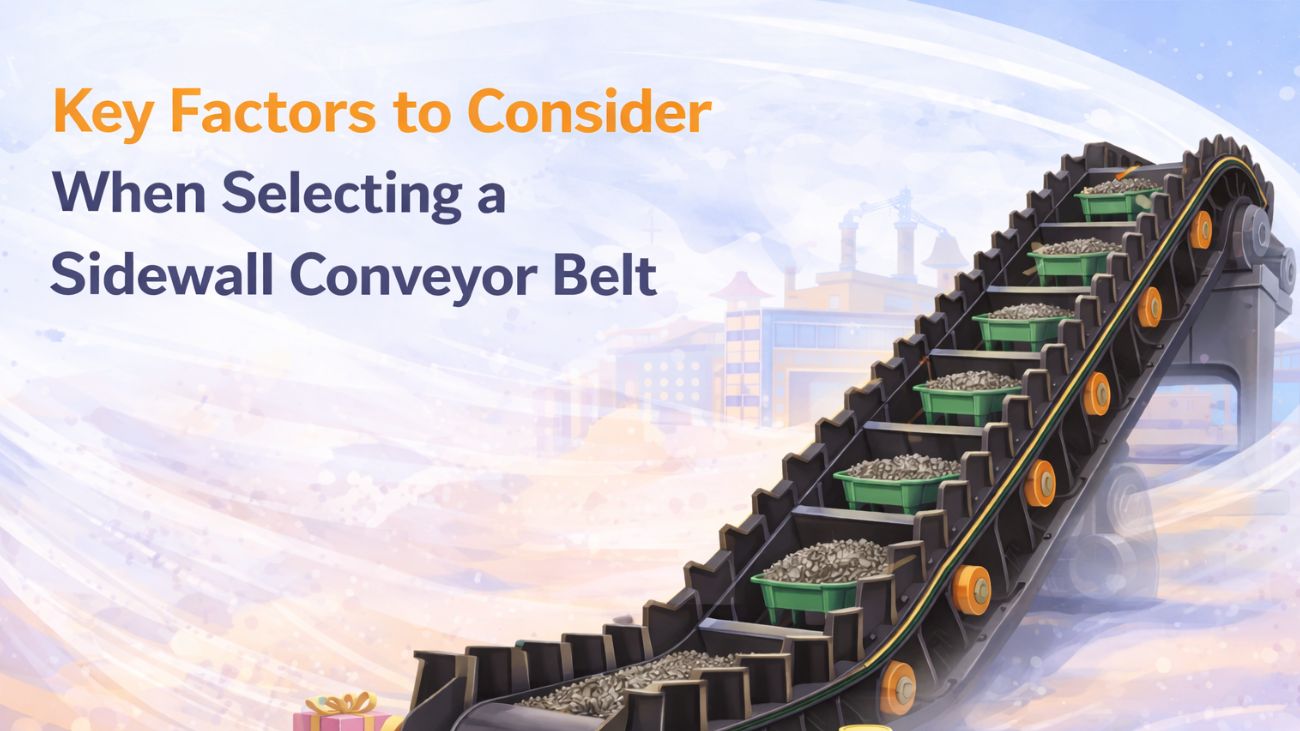
Conveyor belts installed on the sidewalls are very important in the modern material handling systems. These belts are purposefully made with corrugated sidewalls and cleats that aid in preventing spillage of the materials and, as much as possible, effectiveness in the conveying performance. The selection of the appropriate sidewall conveyor belt is not a universal matter, though. Before getting in touch with a sidewall conveyor belt manufacturer in India, there are numerous issues that should be considered in order to make operations run smoothly, safely, and in the long-term.
These are the main considerations in choosing the sidewall conveyor belt to use in whatever application you have.
- Type of Material Being Conveyed
The nature of the material to be transported is the first and most important factor. Bulk materials like grains, coal, cement, sand, fertilizers, and industrial powders are normally handled using the sidewall conveyor belt.
You should consider:
- Mass and bulk of the media
- Granular or powdered form
- Moisture, oil, or stickiness
- Abrasive or corrosive characteristics
Belts of hard or rough material must be of hard-wearing rubber compounds. Sticky or wet material can require special surfaces or coatings on the belt so that it does not accumulate. Knowing your material properties will allow you to choose the appropriate belt strength, thickness, and design.
- Conveyor Application and Usage
The second step is to assess the use of the sidewall conveyor belt, where and how it will be applied. Is it a process that is continuously being produced, or is it a process that is used occasionally? Is it to carry raw materials or semi-finished products, or finished products?
Sidewall conveyor belts are suitable for:
- Steep incline conveying
- Vertical material handling
- Space-saving layouts
- Replacement of several transfer points.
In the case of a strenuous industrial task, such as mining or construction, the belt should be well-built to support the constant load. In the case of food or agricultural use, hygiene and easy cleaning can be more significant. Corresponding the design of the belt to the use would be more efficient and would result in fewer breakdowns.
- Environmental Conditions
The performance of conveyor belts is influenced a lot by the working environment. Such factors as temperature, humidity, dust, and chemical exposure should also be considered.
For example:
- The working conditions of high temperatures might necessitate a heat-enduring belt.
- Belt flexibility at low temperatures is necessary.
- The wet or damp spaces require moisture-resistant materials.
- The belts should be highly chemical-resistant in cases of chemical exposure.
The choice of a sidewall conveyor belt able to sustain these conditions will, in turn, increase the life cycle of the conveyor, and it will also save the maintenance expenses.
- Angle of inclination and Direction of Conveying
The possibility of climbing steep sides and vertical transportation is one of the main reasons why a sidewall conveyor belt should be used. The angle of conveying has a direct impact on the design of the belt.
For higher incline angles:
- The cleat height and cleat spacing should be properly chosen.
- The height of the sidewalls must be adequate to avoid spillage.
- The load should not be deformed with the support of the belt rigidity.
The right design allows the material flow without rollback or loss, even at sharp angles.
- Belt Material and Construction
Conveyor belts put on the sides usually consist of rubber or thermoplastic material, which is reinforced with fabric or steel cords to enhance further strength. The durability and performance of a belt are directly influenced by the type(s) of materials used to make the belt. Tensile strength, flexibility, resistance to wear and tear, and compatibility with pellets and rollers are therefore important factors to consider when choosing a belt, the following characteristics Tensile strength, flexibility, resilience to wear and tear, and compatibility with pellets and rollers must all be considered.
A belt made properly will hold its shape, bear heavy weight, and last longer.
- Maintenance and Service Life
The maintenance needs must not be neglected. The belt of the sidewall conveyor system must be of high quality and should be easily inspected, repaired, and replaced in case of need.
Poor-quality sidewall or cleat belts can crack, drop off, or deteriorate after a short duration, and this may result in frequent downtime. The possible benefits of using a quality belt are to lower the maintenance work, enhance productivity, and lower the total operating cost.
- Space and System Design
Conveyor belts with sidewalls are widely used to maximize space, especially in buildings with constrained floor plans. Before selecting a belt, examine your area and the basic structure of a conveyor system.
A well-designed sidewall belt can:
- Replace multiple conveyors
- Reduce transfer points
- Improve material flow
- Increase operational efficiency.
Using experienced conveyor specialists assists in making sure that the belt fits in your current system.
Conclusion
When choosing the appropriate sidewall conveyor belt, one must be very cautious about the type of material to use, its application, its environment, the incline, and the belt construction. All the factors are crucial towards efficient, safe, and long-life material handling.
When you know these important aspects and select a belt that fits your business requirements, it is possible to enhance productivity, save more time, and have a higher overall performance of your conveyor system. A properly selected sidewall conveyor belt is not an ingredient at all, it is an investment in efficiency and reliability.
What else are you waiting for? Get in touch with a sidewall conveyor belt manufacturer in India without any further delay.

